Reading the Shape of an Italian Farmstead
Reading the shape of an Italian farmstead helps you trace how paths, yards, and outbuildings connect household life with work, without assuming one layout fits all.
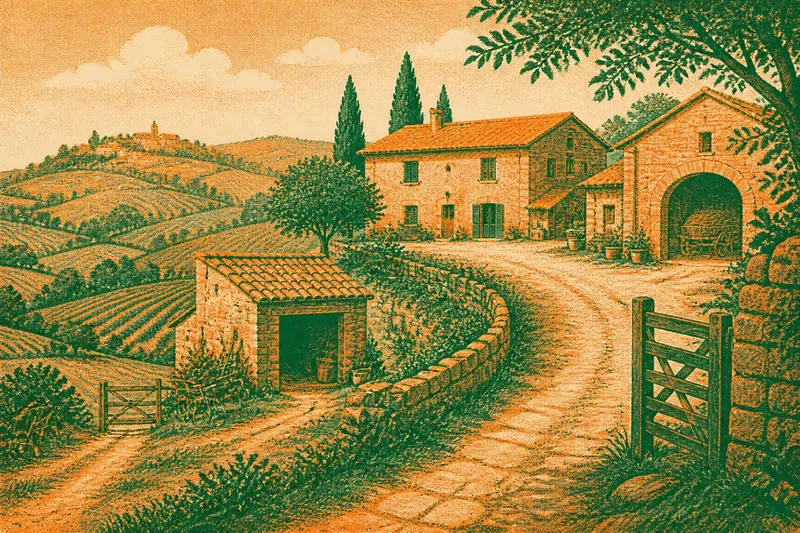
Why does the farmhouse sit apart from the barn, or why does a yard seem to lead nowhere? Reading the shape of an Italian farmstead begins with those questions: the arrangement of paths, doors, and buildings can reveal practical connections between household life and work, but it is not a single design shared across Italy.
When the yard feels confusing
A courtyard can appear to be the farmstead’s center without being a place meant for lingering. It may connect the house to storage rooms, a stable, or a work area, letting people move between tasks without crossing cultivated ground. A wide opening might have suited carts or animals, while a narrower door beside it served everyday foot traffic.
Notice thresholds before assigning a function to each building. Worn paths, changes in paving, gates, and doors facing one another can suggest routes, though they do not prove what traveled along them. A paved strip might have kept mud away from a busy entrance; bare ground might have served several kinds of work at different times.
If the yard’s purpose is unclear, follow its connections before interpreting its center.
When buildings seem disconnected
Farmhouses and outbuildings do not always form a neat cluster. A storehouse may stand apart because its contents needed a drier or cooler position, or because work there involved noise, smells, or frequent movement. Slope, water, a road, and the location of fields could also influence where a structure made sense.
Compare entrances and routes instead of assuming distance signals neglect. Does a path connect the house to a barn without crossing the main yard? Is a low building near a field edge, or does a gate align with a lane? Such details may point to a division between domestic traffic and farm work, although later changes can blur that pattern.
Imagine you arrive at a hillside property where a small outbuilding stands below the house. You notice a track running from its door toward a field gate, then ask the host whether the building’s role has changed. The route supports a possible reading as a work connection, but the host’s account may clarify its current use without settling every detail of its history.
When one layout seems universal
It is tempting to expect a formula: house at the center, stable beside it, storage behind, and a yard in front. In practice, relationships vary with terrain, crops, household needs, available materials, and changes over time. A farmstead in a compact settlement may share walls or access routes with neighbors; a dispersed holding may place work buildings closer to separate fields.
Even nearby properties can differ. One household may have kept animals close for daily care; another may have placed them farther away. A building that resembles a barn might have served another purpose, or several purposes as the farm changed. Avoid treating architectural appearance as a fixed record of one period or activity.
Separate what you see from what you infer: “The doorway faces the lane” is an observation; “the building stored tools” is a hypothesis.
When present use hides the past
A guest room, dining space, or parking area can interrupt older routes and make an earlier arrangement harder to read. A doorway may now be blocked, a former work surface covered, or a path redirected around a newer structure. These changes do not make the farmstead less meaningful; they show how spaces have been adapted to current needs.
Look for differences in materials and circulation without treating them as a puzzle with one correct answer. A newer surface over older paving may point to renovation, but cannot establish what the space was used for. If you are curious, ask a specific, open question: “Did this entrance connect to the fields, or has the route changed?” A host may distinguish family memory from what remains uncertain.
Respect present boundaries while observing. A doorway or yard that looks historically significant may still be part of a working or private area.
What should you notice first?
Begin with the routes linking the house, yard, outbuildings, and field edges. Note visible features such as door width, paving changes, gates, and the direction paths take; then keep possible explanations separate from what you can directly observe.
How can I tell a work entrance from a household entrance?
Notice its width, relation to paths, and whether it opens toward a yard, lane, or field. These details can suggest different kinds of traffic, but present use and later alterations may change the original reading.
Why might a stable or storehouse sit away from the house?
Distance may reflect access to fields, the slope, available space, or separation from household activity. Treat each explanation as a possibility until routes and accounts of current or remembered use add context.
What does a central courtyard tell me?
It can show how buildings and routes meet, but it does not automatically identify a social or ceremonial center. Look at gates, paving, doorways, and the paths people use before assigning it a role.
How should I ask about a building’s former use?
Ask what the structure is used for today and whether its purpose has changed. A concrete question about a doorway, path, or neighboring building is easier to answer than a request to explain the entire property.
When your interpretation stalls
Sometimes the clues remain ambiguous. Keep two or three plausible explanations in mind rather than forcing the layout into a familiar pattern. A low wall could mark an old boundary, contain a slope, or belong to a later garden; the visible form alone cannot settle the question.
For a useful visit, choose one relationship to follow: house to yard, yard to outbuilding, or outbuilding to field route. Note what is directly visible, then ask the host about what remains unclear. Reading the shape of an Italian farmstead this way allows a grounded interpretation without mistaking a compelling possibility for a universal rule.
The farmstead is both a place people inhabit and a setting that may still support work. A final useful clue is the ordinary route connecting its spaces: observe where it leads, and ask before entering areas that appear private or active.